PACKINT - Chocolate Machines

China Top Tabletop Chocolate Tempering Machine Supplier

Choosing a China Top Tabletop Chocolate Tempering Machine Supplier requires more than comparing prices and heating power. Buyers need evidence of stable temperature control, practical design, and dependable after-sales support. A machine may look polished on a showroom floor. Its real test comes during a busy production day, when melted chocolate must remain fluid and glossy for hours.

Peter P. Greweling, a professional chocolatier and author of Chocolates and Confections, explains, “Tempering is the process of precrystallizing cocoa butter in chocolate.” This principle guides every reliable Tabletop Chocolate Tempering Machine. The equipment should heat chocolate evenly, cool it gradually, and maintain the working range without sudden temperature swings. A clear digital display helps operators check conditions quickly. A removable bowl makes cleaning less frustrating. Small details matter.

Experienced suppliers should provide technical specifications, operating instructions, maintenance guidance, and responsive communication. They should also explain capacity honestly. A compact machine designed for five kilograms should not be presented as an industrial solution. Ask about heating methods, temperature accuracy, food-contact materials, warranty coverage, spare parts, and factory quality controls. Request test videos or sample reports when possible.

There is no perfect machine.

Chocolate behaves differently with dark, milk, and white couverture. Room temperature, humidity, and operator habits can change the result. Even a well-built Tabletop Chocolate Tempering Machine cannot correct every preparation mistake. That limitation deserves attention. This guide examines supplier credibility, machine performance, customization options, and purchasing risks, helping confectionery businesses make a practical and informed decision.
China Top Tabletop Chocolate Tempering Machine Supplier

What Is a Tabletop Chocolate Tempering Machine?

China Top Tabletop Chocolate Tempering Machine Supplier

What Is a Tabletop Chocolate Tempering Machine?

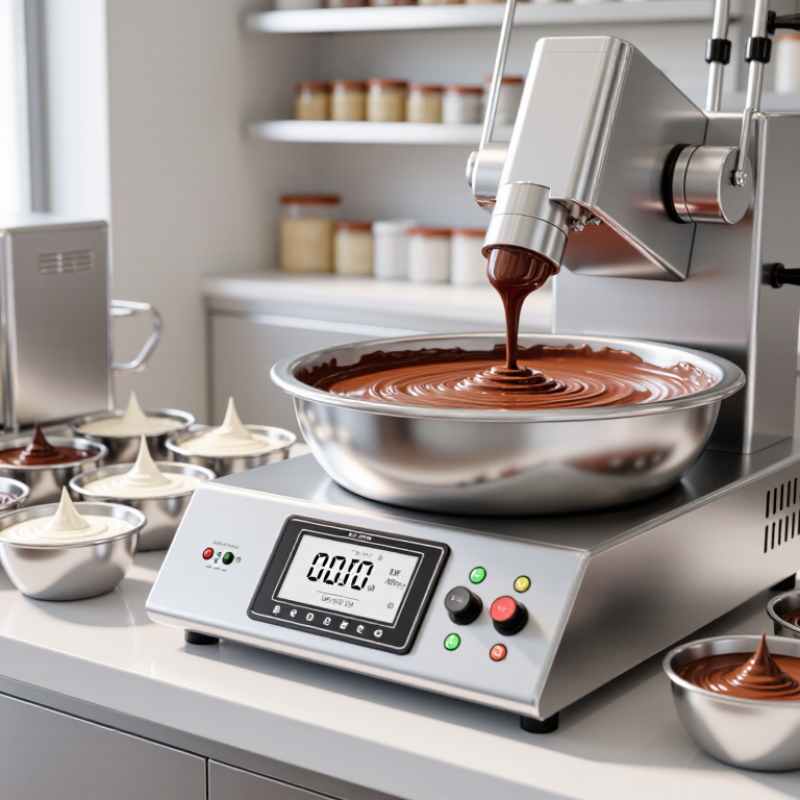
A tabletop chocolate tempering machine is a compact unit for melting, cooling, and gently reheating chocolate. It controls temperature more steadily than a saucepan or microwave. Tempering aligns cocoa butter crystals, creating a smooth finish and clean snap. It also helps prevent dull surfaces and gray streaks. The machine fits on a workbench.

In practical use, a chocolatier melts chocolate inside a heated bowl. The unit then lowers the temperature through controlled cooling. Sensors monitor changes during each stage. An operator still checks viscosity and working temperature. A small thermometer remains useful. Small errors matter. Room temperature, chocolate type, and batch size can change the result.

Most tabletop models suit confectionery shops, bakeries, culinary schools, and small production rooms. Their capacity often ranges from several kilograms to larger countertop batches. Stainless steel contact surfaces support easier cleaning. Removable bowls can improve daily handling. Before choosing equipment, check temperature accuracy, mixing speed, heating range, and cleaning access. A machine may show a correct reading while chocolate remains unevenly mixed. That is not a failure of tempering alone. It may reveal poor scraping, an overloaded bowl, or insufficient cooling time. Reliable results still depend on trained handling and careful observation.

What Is a Tabletop Chocolate Tempering Machine?

A tabletop chocolate tempering machine is a compact appliance that heats, cools, and gently reheats chocolate to create stable cocoa butter crystals. The chart shows representative midpoint temperatures for common chocolate types during melting and working.

Temperature guide: Dark chocolate is typically melted at 45–50°C and worked at 31–32°C; milk chocolate at 40–45°C and 29–30°C; white chocolate at 38–43°C and 28–29°C. Exact settings vary by chocolate formulation.

How Tabletop Chocolate Tempering Machines Work

China Top Tabletop Chocolate Tempering Machine Supplier

A tabletop chocolate tempering machine controls heat, cooling, and gentle agitation in one compact unit. Solid chocolate melts inside a heated bowl. The machine then lowers the temperature gradually, encouraging stable cocoa butter crystals to form. It raises the chocolate slightly afterward, removing unstable crystals without overheating the batch.

The agitator keeps the mixture moving. This helps distribute heat evenly and reduces thick spots near the bowl wall.

Dark chocolate often melts around 45–50°C, cools near 27–28°C, and works around 31–32°C. Milk and white chocolate usually require lower temperatures. Exact settings depend on the recipe, cocoa butter content, and machine calibration.

Small details matter. Clean, dry utensils prevent moisture-related seizing. A reliable China tabletop chocolate tempering machine supplier should provide clear temperature controls, food-contact material information, and practical operating guidance.

In workshop use, I check the chocolate with a thermometer instead of trusting the display alone. Sensors can drift. The process is not always tidy. A short test batch may reveal uneven cooling, excessive agitation, or a weak heating response.

Operators should record each batch temperature and adjust slowly, because a few degrees can change shine, snap, and contraction. A simple streak test on parchment can show whether the chocolate sets evenly.

Key Features of Top Chinese Suppliers

China Top Tabletop Chocolate Tempering Machine Supplier

Top Chinese suppliers focus on stable temperature control, practical design, and repeatable production results. A reliable tabletop machine should heat chocolate gently, usually within a narrow temperature range, without creating hot spots. Stainless steel contact parts improve hygiene and daily durability. A removable bowl also makes cleaning faster between batches.

Good suppliers provide clear technical data, factory testing records, and responsive after-sales support. Ask about motor life, sensor accuracy, warranty coverage, and spare-part availability. A useful supplier should explain the machine’s limits, not only its advantages. For example, capacity may change with chocolate type, room temperature, and operator habits. A polished catalog is not proof of consistent performance. Sample testing matters.

Tips: Request a live video test with your chocolate. Check whether the machine maintains a smooth flow after several heating cycles. Inspect the scraper, control panel, and drain area closely. Ask for an English manual and a temperature calibration report. Small details matter. One overlooked cleaning gap can slow production every day.

China Top Tabletop Chocolate Tempering Machine Supplier - Key Features of Top Chinese Suppliers
Evaluation Dimension Typical Market Specification Practical Benefit Buyer Verification Point
Tabletop Capacity Common working capacities range from approximately 5 kg to 30 kg per batch. Supports small confectionery shops, bakeries, dessert counters, and product demonstrations. Confirm whether the stated capacity means total bowl volume, usable chocolate load, or hourly throughput.
Chocolate Temperature Control Digital temperature control is commonly used, with operating settings typically covering about 20°C to 50°C. Helps maintain stable melting, cooling, and working temperatures for different chocolate types. Ask for temperature accuracy, sensor location, calibration procedure, and recovery time after chocolate is added.
Tempering Method Most compact units use controlled heating and cooling with an auger, pump, or continuous circulation system. Improves crystal formation and helps produce chocolate with a smoother finish and better snap. Request a demonstration using dark, milk, and white chocolate because each requires different working temperatures.
Food-Contact Construction Food-contact parts are commonly manufactured from stainless steel, frequently specified as 304 stainless steel. Provides corrosion resistance, easier cleaning, and suitability for regular food-processing use. Verify the material grade for the bowl, auger, outlet, seals, and internal surfaces rather than only the external housing.
Heating and Cooling Power Compact commercial models commonly use approximately 1 kW to 3 kW of connected power, depending on capacity and cooling design. Adequate power supports faster start-up and more stable temperature recovery during production. Compare rated power with batch size, ambient temperature, cooling method, and local electrical supply.
Electrical Compatibility China-market configurations commonly use 220 V and 50 Hz; export versions may be available for 110 V or 60 Hz systems. Reduces installation risk and helps match the machine to the destination market. Confirm voltage, frequency, phase, plug type, fuse rating, and whether a transformer is required.
Control Interface Digital displays, independent temperature settings, heating controls, and pump or auger controls are common features. Makes daily operation easier and improves repeatability between batches. Check language options, alarm functions, password protection, temperature display resolution, and operator instructions.
Cleaning and Maintenance Preferred designs include removable contact parts, accessible outlets, smooth internal surfaces, and tool-free or low-tool disassembly. Shortens cleaning time and helps prevent old chocolate from affecting new batches. Request cleaning instructions, spare-part diagrams, seal replacement guidance, and recommended cleaning temperatures.
Safety Features Common safety provisions include over-temperature protection, overload protection, grounding, and emergency stop functions on applicable models. Protects operators and reduces the risk of equipment damage during extended operation. Check safety labels, electrical test records, emergency-stop behavior, and conformity documents required in the destination country.
Export Documentation Export-ready documentation may include a commercial invoice, packing list, user manual, wiring diagram, and applicable conformity declarations. Supports customs clearance, installation, staff training, and after-sales service. Confirm document language, product identification, electrical data, country-of-origin details, and certification scope.
Warranty and Spare Parts Commercial quotations commonly define a limited warranty period and identify replaceable parts such as seals, sensors, belts, pumps, or heating elements. Improves serviceability and reduces downtime when wear parts need replacement. Obtain the warranty exclusions, spare-part prices, lead times, technical support process, and troubleshooting responsibilities in writing.
Quality Assessment Priority The most important comparison factors are temperature stability, usable capacity, construction quality, cleaning access, electrical safety, and service support. Provides a more reliable basis for comparing suppliers than purchase price alone. Use the same test chocolate, batch size, ambient conditions, and acceptance criteria when evaluating multiple quotations.

How to Evaluate Machine Quality and Supplier Reliability

China Top Tabletop Chocolate Tempering Machine Supplier

Evaluating a tabletop chocolate tempering machine requires more than checking its price. Inspect the heating vessel, agitator, control panel, and food-contact surfaces closely. Stainless steel should feel smooth, without sharp welds or hidden corners. These details affect cleaning and long-term hygiene. Ask for temperature test records, not only attractive product photographs. During a live trial, measure chocolate at several points with a calibrated thermometer. Stable readings within about 0.5°C indicate better control. Test dark, milk, and white chocolate separately. Each type reacts differently.

Supplier reliability appears through practical support. Request a clear manual, wiring information, maintenance schedule, and spare-parts list. Ask how quickly the supplier answers technical questions. A serious supplier should explain motor life, heating protection, and recommended cleaning methods. Check whether the machine can run continuously for several hours without unusual noise or temperature drift. Watch the demonstration carefully. A polished showroom is not proof of factory consistency. Batch records, inspection reports, and relevant safety documents provide stronger evidence.

A small weakness may matter. One supplier I reviewed offered excellent temperature accuracy but unclear replacement-part pricing. That gap deserved further questions. Request a sample unit or independent inspection before placing a large order. Confirm packaging quality, delivery communication, warranty terms, and after-sales training in writing. Reliability is built through evidence, not confident promises. Experience can reveal problems early, but even experienced buyers should keep testing assumptions.

Applications, Maintenance, and Buying Considerations

China Top Tabletop Chocolate Tempering Machine Supplier

Tabletop chocolate tempering machines suit bakeries, confectionery workshops, cafés, and training rooms. They handle small batches for molded pieces, coated snacks, decorations, and filled chocolates. A stable tempering curve improves shine, snap, and resistance to melting. However, each chocolate type behaves differently. Dark, milk, and white chocolate require careful temperature control. Operators should record working temperatures during real production, not rely only on display readings.

Maintenance directly affects tempering consistency. Remove leftover chocolate after every production cycle. Use approved food-contact cleaning tools, and keep water away from electrical components. Inspect scrapers, seals, sensors, and stirring parts regularly. A sensor can appear accurate while slowly drifting. Periodic calibration is worth the effort. In practice, rushed cleaning often causes more faults than heavy daily use.

Tips: Check usable capacity, heating method, temperature accuracy, and control response before buying. Ask for food-contact material details, operating instructions, spare-part availability, and service support. Request a sample test with your preferred chocolate. A compact machine may save space, but an undersized bowl can create uneven heating and frequent refilling. Consider power requirements, noise, cleaning access, warranty terms, and operator training. A low purchase price can become expensive when parts are difficult to obtain. Review the machine after several weeks of use, because early assumptions are sometimes wrong.