PACKINT - Chocolate Machines

7 Chocolate Refining Process Tips for Buyers

Choosing refining equipment is not just a matter of comparing capacity figures. The Chocolate Refining Process shapes particle size, mouthfeel, flow, and the consistency of each batch. A machine that looks impressive on paper may perform differently with your recipe, cocoa solids, or production schedule. Food engineer Richard W. Hartel’s published work highlights how particle size and fat content influence chocolate’s flow and texture. In practical terms, buyers should test their own formulation, not rely only on a supplier’s demonstration.

The seven tips in this guide help buyers ask more useful questions. Check the target particle size and how it is measured. Compare real throughput with your expected batch size. Ask about temperature control, energy use, cleaning access, and wear parts. Request a product trial, and examine the chocolate’s texture and flow afterward. These details matter. So does service: a delayed replacement part can leave a production line idle.

Still, a checklist cannot predict every production problem. Recipe changes, operator habits, and room conditions may affect results. Buyers sometimes focus too heavily on the machine’s headline capacity. That is understandable, but incomplete. Use the tips as a starting point, then confirm performance with your own ingredients and operating conditions. A careful trial may reveal an awkward limitation before it becomes an expensive surprise.
7 Chocolate Refining Process Tips for Buyers

Understanding the Purpose and Stages of Chocolate Refining

Chocolate refining turns a coarse mixture of cocoa solids, sugar, and sometimes milk powder into a smoother, more uniform chocolate mass. A typical line mixes ingredients, passes the mass through a roller refiner, then conches it to develop flavor and improve flow. Refining mainly reduces solid particles; conching is a separate, later stage. That distinction matters when comparing equipment offers.

Particle size affects mouthfeel and processing behavior. A study in the Journal of Food Engineering by Afoakwa and colleagues examined chocolate with particle sizes from 18 to 50 micrometers and found that size distribution influenced texture and rheology. Buyers should therefore ask how a supplier measures particle size, and whether the result reflects the full batch. A single target number can mislead. Small test samples may not behave like a production run.

Capacity also deserves context. The International Cocoa Organization’s 2023/24 quarterly bulletin reported global cocoa grindings at roughly 4.8 million tonnes, indicating the scale of demand for consistent processing. That figure describes grinding, not refining capacity. Ask for trial data using your own recipe, including throughput, temperature, and cleaning time. Watch the discharge: a glossy ribbon is useful evidence, but not proof of consistent fineness. Even a well-written specification leaves questions.

Choosing a Refining System for Your Production Needs

Choosing a refining system starts with the product, not the machine’s advertised capacity. A smooth milk chocolate and a coarse, inclusions-rich recipe place different demands on particle-size control and circulation. The ICCO’s Quarterly Bulletin of Cocoa Statistics estimated global grindings at 4.818 million tonnes in 2023/24. That figure signals a large, varied processing market, but it does not tell you what your own line needs. Match the refiner’s stable output to your actual batch size, operating hours, and planned growth.

Ask suppliers to test your recipe, then review particle-size distribution, temperature rise, cleaning time, and product loss. Afoakwa, Paterson, and Fowler’s 2008 study in European Food Research and Technology examined how particle size affects chocolate rheology and sensory properties. Request a particle-size curve, not just an average. Small differences matter. Also check whether the system handles your fat content and any inclusions without frequent stoppages. Compare energy use per tonne and maintenance access, too. A polished trial result can hide awkward cleaning or inconsistent performance at full scale. I would still treat short factory trials cautiously; real production rarely behaves as neatly as a test run.

7 Chocolate Refining Process Tips for Buyers

Choosing a Refining System for Your Production Needs

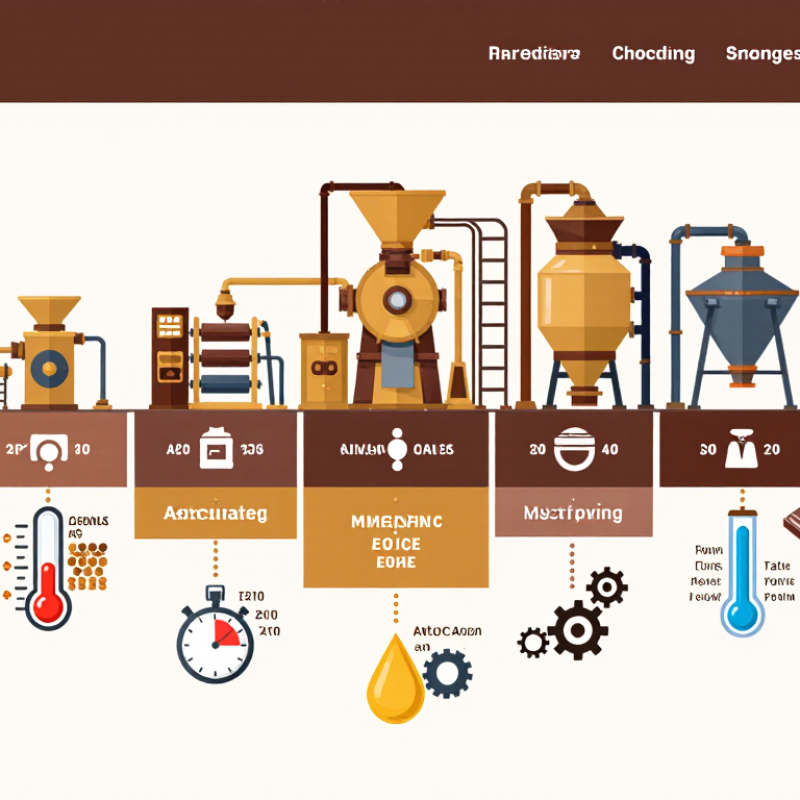
Use these seven criteria to compare systems against your recipe, required particle fineness, production volume, and operating plan. Ratings are an illustrative 1–5 planning rubric, not measured market data; set priorities for your own production needs.

Comparing Particle Size, Capacity, and Product Quality

Buyers should compare the full particle-size distribution, not just the average. Afoakwa, Paterson, and Fowler’s 2008 Journal of Food Engineering study examined dark chocolate particle sizes across roughly 18–50 μm and found that particle size affected flow behavior. A practical target often sits near 20–30 μm, but recipe and sensory goals matter. Ask for d90 data, which shows whether a coarse fraction remains. Smoothness can hide a few gritty particles.

Capacity claims need context. Check kilograms per hour at the required particle size, recipe, and operating temperature—not motor power alone. Request trial results at your expected batch size. Record inlet and outlet temperatures, refining time, and energy use. Small details matter. A machine that reaches rated output only with a thinner recipe may not fit your production plan.

Assess quality across several runs. Measure particle size, viscosity, and yield stress, then taste samples at the same temperature. Look for stable flow, clean flavor, and no detectable grittiness. Ask suppliers for test methods and repeatability data. One result is not enough. I would also keep a sample from each trial; measurements do not capture every defect, and sensory judgments can be inconsistent.

Assessing Controls, Maintenance, and Operating Costs

7 Chocolate Refining Process Tips for Buyers

Assess controls before comparing machine prices. Ask suppliers to show live readings for motor load, product temperature, and batch time. During a factory trial, record these values at different recipes and fill levels. A stable temperature matters: excess heat can affect texture, while poor control may extend processing time. Check whether alarms identify a fault clearly, or merely flash a code operators cannot interpret.

Maintenance deserves equal attention. Request service intervals, wear-part prices, and realistic replacement times for seals, bearings, and scraper blades. The U.S. Department of Energy’s Operations & Maintenance Best Practices guide reports that predictive maintenance can cost 8–12% less than preventive maintenance, and 30–40% less than reactive maintenance. Those are broad estimates, not guaranteed savings for a chocolate line. Still, they make sensor access and maintenance records worth checking. A dashboard is not proof.

Operating costs hide in the details. The DOE’s 2014 assessment found motor-driven systems used about 54% of electricity in U.S. manufacturing. That figure is not specific to chocolate refining, but it explains why motor efficiency, load matching, and standby power deserve scrutiny. Ask for measured kilowatt-hours per tonne under your operating conditions. Include cleaning time, downtime, and operator hours in the comparison. Small gaps add up. Estimates can mislead when trial batches are too short.

Verifying Supplier Support, Testing, and After-Sales Service

7 Chocolate Refining Process Tips for Buyers

Reliable supplier support matters because refining settings affect texture, throughput, and rework. The International Cocoa Organization’s 2023/24 forecast estimated global cocoa grindings at about 4.8 million tonnes, underscoring the scale of production behind today’s chocolate market. Ask suppliers to explain commissioning, operator training, and how they diagnose inconsistent particle size or rising product temperature. Get response times in writing. A polished brochure is not a service plan.

Tip: Request a witnessed factory acceptance test using your actual recipe, not only a standard sample. Record throughput, refining time, product temperature, and particle size; around 20–30 μm is a common target range for smooth chocolate. Ask for the measurement method and calibration records. Small details matter. Confirm that test results are repeatable across batches, since one good run can hide variation.

Before purchase, verify spare-parts availability, remote troubleshooting hours, and local technician coverage. Ask the supplier to share a sample maintenance schedule and a clear escalation path for breakdowns. Check whether training includes cleaning, wear-part inspection, and safe restart procedures. A response promised “as soon as possible” is vague. I would also ask for references from comparable production lines, then speak with operators—not only managers—about actual service delays and unresolved issues.