
How to Choose the Best Cocoa Grinding Machine?
Choosing the right Cocoa Grinding Machine can determine whether a chocolate line delivers smooth, consistent cocoa liquor or repeated production problems. The decision involves more than motor power. Operators must examine cocoa bean capacity, grinding fineness, heat control, energy use, cleaning access, and maintenance support.
Stephen T. Beckett, a respected cocoa-processing authority, explains, “Grinding changes more than particle size; it influences texture, flow, and flavor.” This principle matters on the factory floor. A machine running too hot may damage delicate cocoa aromas. A poorly adjusted mill can leave coarse particles, uneven texture, or excessive waste.
Start with the product. Are you producing cocoa liquor, cocoa paste, or chocolate ingredients? Each application may require different grinding technology. Stone grinders can support traditional processing, while pin mills, bead mills, and colloid mills offer different levels of control. Capacity also deserves careful attention. A compact workshop may not need an industrial system, but buying too small can create constant bottlenecks.
Look closely at the details.
Check the cooling design.
Ask about spare parts.
Request test results.
Suppliers often highlight maximum output, yet real performance depends on cocoa moisture, roasting conditions, and operator experience. This is where buyers should remain cautious. The cheapest Cocoa Grinding Machine may become expensive through downtime, difficult cleaning, and unstable particle size. A practical evaluation should include factory trials, safety features, warranty terms, and long-term technical support. Good equipment is not merely powerful. It should fit the process, the people, and the product quality you intend to protect.
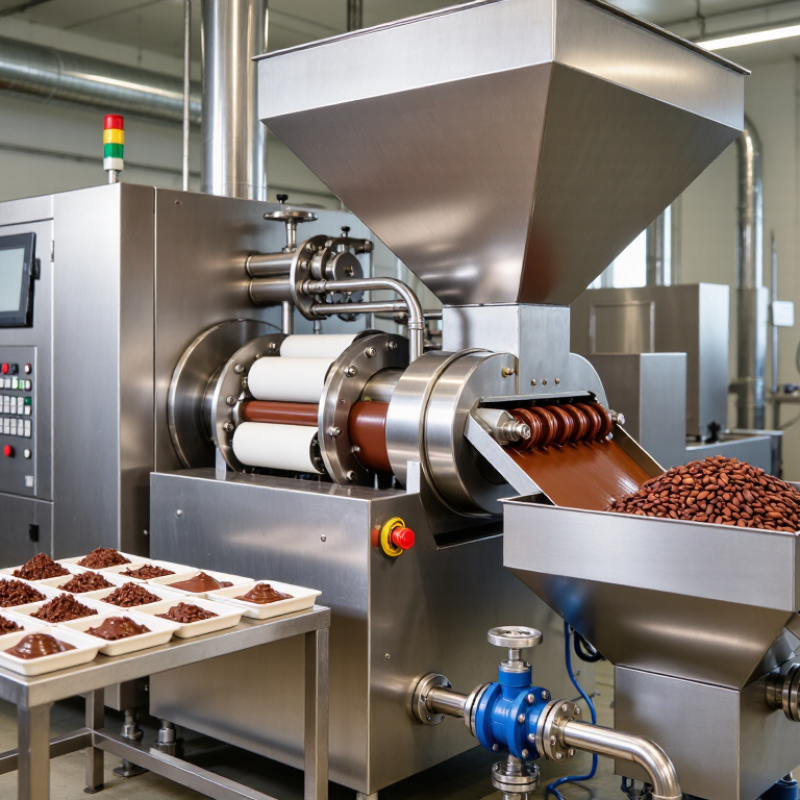
Define Cocoa Output Goals: Match 50 kg/h Pilot Needs to 5 t/h Production
Choosing a cocoa grinding machine starts with output, not motor size. A 50 kg/h pilot line and a 5 t/h production line differ by 100 times. That gap changes feeding, cooling, cleaning, and maintenance requirements.
ICCO’s 2023/24 Cocoa Market Report estimated global cocoa grindings at about 4.85 million tonnes. This figure shows the scale of industrial demand, but it does not define your factory’s needs. A pilot machine should handle small batches consistently, with easy sampling and fast recipe changes. For 5 t/h, continuous feeding becomes essential. Operators also need stable temperature control, because excessive heat can affect cocoa aroma and viscosity. Ask suppliers to state rated output, not only peak capacity. The difference matters.
Particle size must be tested with your actual cocoa liquor, moisture level, and target application. A machine producing 50 kg/h in a demonstration may perform differently during an eight-hour shift. I would request a witnessed trial using representative beans. Measure kilograms per hour, product temperature, energy use, and cleaning time. USDA Foreign Agricultural Service cocoa reports also show that cocoa processing depends on regional supply and product specifications, so flexibility has practical value. Bigger is not always better. A five-ton machine may be wasteful for seasonal demand. Conversely, choosing a pilot-scale unit for future production can create bottlenecks, overtime, and uneven quality. The correct choice is the capacity your process can reliably sustain, not the largest number on a brochure.
How to Choose the Best Cocoa Grinding Machine? - Define Cocoa Output Goals: Match 50 kg/h Pilot Needs to 5 t/h Production
| Target Cocoa Output | Typical Application | Suitable Grinder Configuration | Indicative Motor Range | Typical Final Particle Size | Cooling Requirement | Recommended Operating Mode | Main Selection Consideration |
|---|---|---|---|---|---|---|---|
| 50 kg/h | Laboratory trials, recipe development and pilot-scale validation | Small colloid, stone or pin-type grinder with adjustable feed control | 5.5–15 kW | Approximately 50–100 μm, depending on the recipe and grinding system | Air cooling or a small water-jacket circuit | Batch or short-duration continuous operation | Easy cleaning, rapid product changeover and accurate low-rate feeding |
| 100–300 kg/h | Small commercial production and specialty cocoa liquor | Continuous colloid or impact grinder with a controlled recirculation loop | 15–37 kW | Approximately 40–80 μm | Water jacket normally recommended to control product temperature | Continuous operation with optional recirculation | Stable throughput, low dead volume and consistent particle-size distribution |
| 500 kg/h | Small industrial lines and regional cocoa processing | Heavy-duty colloid, pin or impact mill integrated with a buffer tank | 30–75 kW | Approximately 30–70 μm | Dedicated cooling water circulation is generally required | Continuous operation, often with one-pass or two-pass grinding | Wear resistance, pump capacity and protection against temperature rise |
| 1 t/h | Medium-scale cocoa liquor production and compound chocolate preparation | Industrial continuous grinder with metering feeder, holding tank and inline temperature control | 75–160 kW | Approximately 25–60 μm | Closed-loop water cooling for the grinding chamber and product circuit | Continuous multi-pass or parallel-grinder operation | Automation, pump sizing, maintenance access and process monitoring |
| 2 t/h | Large regional factories and integrated chocolate plants | Multiple industrial grinding units in parallel or a high-capacity staged system | 110–250 kW | Approximately 20–50 μm | Continuous chilled-water or controlled-temperature cooling system | 24-hour continuous production with redundancy preferred | Capacity redundancy, energy consumption and uninterrupted material flow |
| 5 t/h | Large industrial cocoa processing and high-volume chocolate production | Parallel high-capacity grinders with automated feeding, buffering, cooling and process control | 250–500 kW total installed power | Approximately 15–40 μm when the complete process is correctly configured | Industrial closed-loop cooling with heat-exchanger capacity matched to the load | Fully continuous operation with automated control and duty/standby planning | Total cost of ownership, serviceability, energy efficiency and production reliability |
Data basis: The capacity, motor and particle-size figures are typical engineering ranges for cocoa liquor grinding applications. Actual performance depends on cocoa bean variety, roasting level, liquor fat content, feed temperature, moisture, desired fineness, number of passes and cooling conditions.
Related Posts
-
Cocoa Powder Processing Machine Insights for Seeking the Best Options
-
Essential Checklist for Selecting the Best Cocoa Grinding Machine in 2023
-
How to Identify Quality Manufacturers for the Best Cocoa Grinding Machine
-
Ultimate Comparison: Top Tempering Machines for Chocolate - Find the Perfect Fit for Your Production Needs
-
Unlocking the Secrets of the Best Cocoa Drying Machine Key Specifications for Optimal Performance
-
Ultimate Checklist for Choosing the Best Cocoa Processing Machine for Your Factory