
7 Best Cocoa Beans Processing Machines for Global Buyers
Global cocoa processing is entering a more demanding phase. The International Cocoa Organization’s 2023/24 reports describe a severely disrupted supply balance, with production and grindings affected by weather, disease, and limited bean availability. These pressures make equipment selection more important for manufacturers, traders, and investors.
A reliable Cocoa Beans Processing Machine must do more than increase throughput. It should support cleaning, grading, roasting, cracking, winnowing, grinding, and temperature control with consistent results. ISO 2451:2017 emphasizes quality requirements for cocoa beans, including moisture, defects, and foreign matter. Therefore, machine design should match bean origin, batch size, factory layout, and final product specifications.
Small details matter. A weak winnower may leave shell fragments in nibs. Uneven roasting can flatten aroma and create bitter notes. Operators should inspect stainless-steel contact surfaces, dust-control systems, bearing access, emergency stops, and calibration records. These details often reveal the real manufacturing standard.
FAO agricultural data also shows how cocoa production remains concentrated in tropical regions, where humidity and transport conditions can challenge storage. Buyers should therefore compare drying capacity, energy consumption, spare-part availability, and after-sales support—not only advertised output. The “best” machine is rarely the largest one. Sometimes, this is overlooked.
This guide reviews seven processing machines for global buyers. It considers practical capacity, product consistency, maintenance demands, food-safety alignment, and total ownership cost. Performance figures should still be verified through factory trials. Marketing brochures are not enough. Real cocoa beans are variable, and even excellent equipment requires trained operators and disciplined quality control.
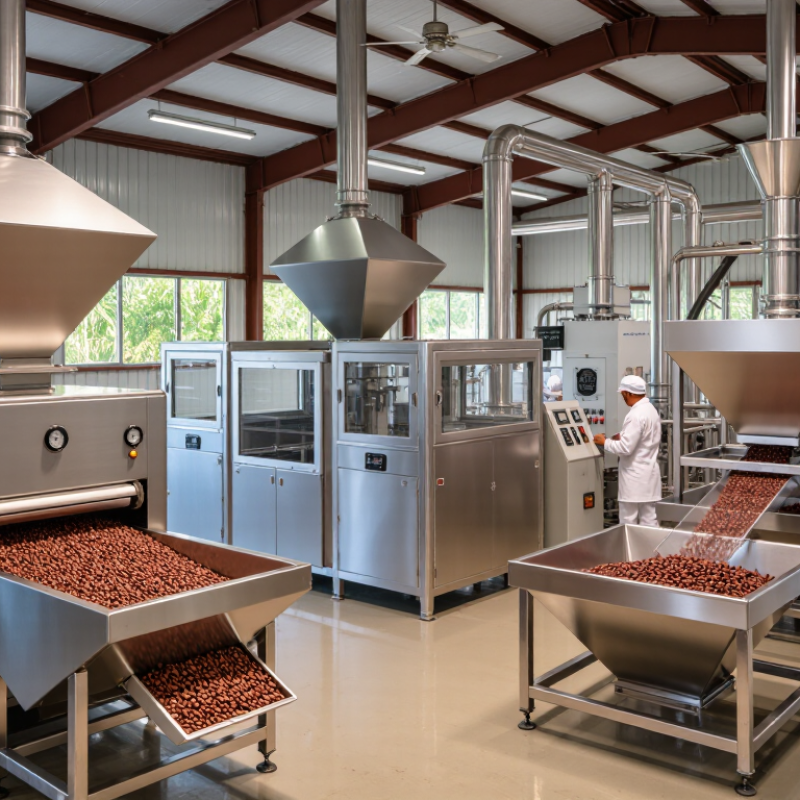
Cocoa Processing at a Glance: 6–8% Bean Moisture and Core Quality Metrics
Cocoa processing begins with moisture control, not machine speed. Well-dried beans usually contain 6–8% moisture before storage or roasting. Higher levels can encourage mold, uneven roasting, and unstable flavor. Lower levels may create brittle beans and unnecessary weight loss. A reliable moisture meter should check several samples from each lot, not only the surface layer.
The seven essential machine groups include cleaners, destoners, roasters, crackers, winnowers, grinders, and presses. Their performance depends on bean condition. A roaster may show excellent temperature control, yet produce uneven flavor when bean moisture varies widely. Before purchasing equipment, buyers should review throughput, temperature accuracy, dust control, adjustment ranges, and cleaning access. Core quality metrics include bean count, cut-test results, fermentation level, shell percentage, defect rate, pH, and cocoa fat content. Numbers help, but they do not replace a trained sensory check.
Tips: Measure moisture after drying and again before roasting. Keep samples in sealed bags during testing. Record readings by lot and storage location. Watch the first production run closely. Small differences matter. A practical mistake is trusting one test result too much. I have seen apparently uniform beans roast unevenly because moisture was checked near the bag opening only. Good processing decisions combine instruments, visual inspection, and careful operating records.
| 7 Best Cocoa Beans Processing Machines for Global Buyers - Cocoa Processing at a Glance: 6–8% Bean Moisture and Core Quality Metrics | |||||||
|---|---|---|---|---|---|---|---|
| No. | Machine Type | Primary Processing Function | Typical Throughput Range | Recommended Feed Condition | Main Quality Metrics | Typical Product Output | Key Selection Considerations |
| 1 | Cocoa Bean Cleaner | Removes stones, dust, metal fragments, fibers, broken beans and other foreign materials before roasting. | 500–5,000 kg/h | Fermented and dried beans, normally at 6–8% moisture. | Foreign matter, cleaning loss, bean breakage, particle separation efficiency and magnetic-metal removal. | Clean whole cocoa beans with consistent size distribution. | Screen configuration, aspiration control, dust collection, food-contact materials and ease of cleaning. |
| 2 | Cocoa Bean Roaster | Develops cocoa aroma and flavor while reducing moisture and lowering microbial load through controlled heating. | 100–2,000 kg/h | Clean beans at approximately 6–8% moisture; uniform bean size improves roasting consistency. | Roasting temperature, residence time, final moisture, color, aroma development and microbial reduction. | Roasted cocoa beans ready for cracking and winnowing. | Batch or continuous design, heating method, airflow, temperature uniformity, heat recovery and control accuracy. |
| 3 | Cocoa Bean Cracker and Winnower | Cracks roasted beans and separates cocoa nibs from shells using controlled impact and air classification. | 300–3,000 kg/h | Roasted beans cooled to a stable handling temperature; excessive residual moisture should be avoided. | Shell content, nib recovery, whole-nib yield, fine-particle loss, uncracked beans and shell carryover. | Clean cocoa nibs and separated cocoa shells. | Adjustable cracking gap, multi-stage aspiration, shell separation accuracy, low nib loss and dust control. |
| 4 | Cocoa Nib Grinder | Grinds cocoa nibs into cocoa liquor by reducing particle size and releasing cocoa butter. | 100–2,500 kg/h | Clean nibs with low shell content and stable roasted flavor; feed temperature must support efficient grinding. | Particle-size distribution, liquor temperature, viscosity, fat separation, throughput and shell contamination. | Smooth or semi-fluid cocoa liquor for pressing, chocolate manufacture or further refining. | Grinding system, cooling arrangement, wear resistance, sanitary design and protection against overheating. |
| 5 | Cocoa Liquor Press | Separates cocoa butter from cocoa solids under hydraulic or mechanical pressure. | 200–2,000 kg liquor/h | Uniform cocoa liquor with controlled temperature and stable viscosity. | Butter yield, residual fat in press cake, pressing pressure, cycle time, butter clarity and cake moisture. | Cocoa butter and cocoa press cake. | Number of pressing pots, pressure control, filtration, hydraulic reliability, cleaning access and expected fat level in cake. |
| 6 | Cocoa Cake Breaker and Powder Mill | Breaks pressed cocoa cake and pulverizes it into cocoa powder with a controlled fineness. | 100–1,500 kg/h | Press cake cooled sufficiently for milling and with a controlled residual fat level. | Powder fineness, particle-size distribution, residual fat, product temperature, color and bulk density. | Natural or alkalized cocoa powder, depending on the upstream process. | Pin or hammer milling technology, classifier adjustment, cooling, explosion protection and powder recovery. |
| 7 | Cocoa Liquor Refiner and Conche | Refines cocoa liquor and chocolate ingredients, then reduces acidity and develops a smoother flavor through controlled mixing and aeration. | 100–3,000 kg/batch or 200–2,000 kg/h | Cocoa liquor and formulated chocolate mass with controlled temperature and ingredient ratios. | Final particle size, viscosity, moisture, acidity, flavor balance, temperature profile and conching time. | Refined cocoa liquor or finished chocolate mass with improved texture and aroma. | Refining gap, batch size, mixing intensity, temperature control, vacuum capability and recipe flexibility. |
| Reference quality baseline: Properly fermented and dried cocoa beans commonly enter processing at approximately 6–8% moisture. Actual operating conditions vary by bean origin, variety, bean size, roasting profile, equipment configuration and product specification. Throughput figures are typical planning ranges rather than guaranteed machine capacities. | |||||||
Related Posts
-
How to Identify Quality Manufacturers for the Best Cocoa Grinding Machine
-

Overcoming Challenges in Cocoa Beans Processing: Insights and Solutions for Global Buyers
-
Tips for Sourcing Quality Cocoa Roasting Machines in a Competitive Global Market
-
Essential Checklist for Selecting the Best Cocoa Grinding Machine in 2023
-
Ultimate Checklist for Choosing the Best Cocoa Processing Machine for Your Factory
-
Maximizing Value with Exceptional Support and Maintenance Cost Efficiency in Chocolate Processing Machines