PACKINT - Chocolate Machines

Top Cocoa Grinding Machine Manufacturers and Suppliers

Choosing the right Cocoa Grinding Machine can shape product quality, production efficiency, and long-term operating costs. A reliable machine should create a smooth, consistent cocoa liquor while protecting flavor and controlling heat. It must also suit the factory’s batch size, power supply, cleaning routine, and available floor space. Small details matter.

This guide examines leading cocoa grinding machine manufacturers and suppliers from a practical purchasing perspective. It considers machine construction, grinding performance, temperature management, output capacity, maintenance access, and food-contact materials. Supplier experience also matters. An established company should provide clear technical specifications, installation guidance, operator training, and responsive after-sales support. Certifications and documented quality procedures can strengthen confidence, but buyers should still verify every claim independently.

Real production conditions are rarely perfect. Cocoa beans may vary in moisture, roast level, and fat content. One machine may perform well in laboratory tests yet require adjustment on a busy production line. That difference deserves attention. No supplier is perfect, and published capacity figures may depend on specific raw materials. Buyers should request sample trials, reference customers, spare-parts details, and realistic energy estimates before making a decision. A useful comparison should therefore balance price with reliability, service access, sanitation, and future expansion. The best choice is not always the largest or most expensive model. It is the machine that delivers stable results under the buyer’s actual working conditions. That is where careful evaluation begins.
Top Cocoa Grinding Machine Manufacturers and Suppliers

Types of Cocoa Grinding Machines and Their Main Applications

Top Cocoa Grinding Machine Manufacturers and Suppliers

Types of Cocoa Grinding Machines and Their Main Applications

Cocoa grinding machines differ by particle size, capacity, heat control, and product texture. Choosing a supplier requires more than comparing motor power. Operators should examine sanitation design, spare-part access, safety controls, and verified performance data.

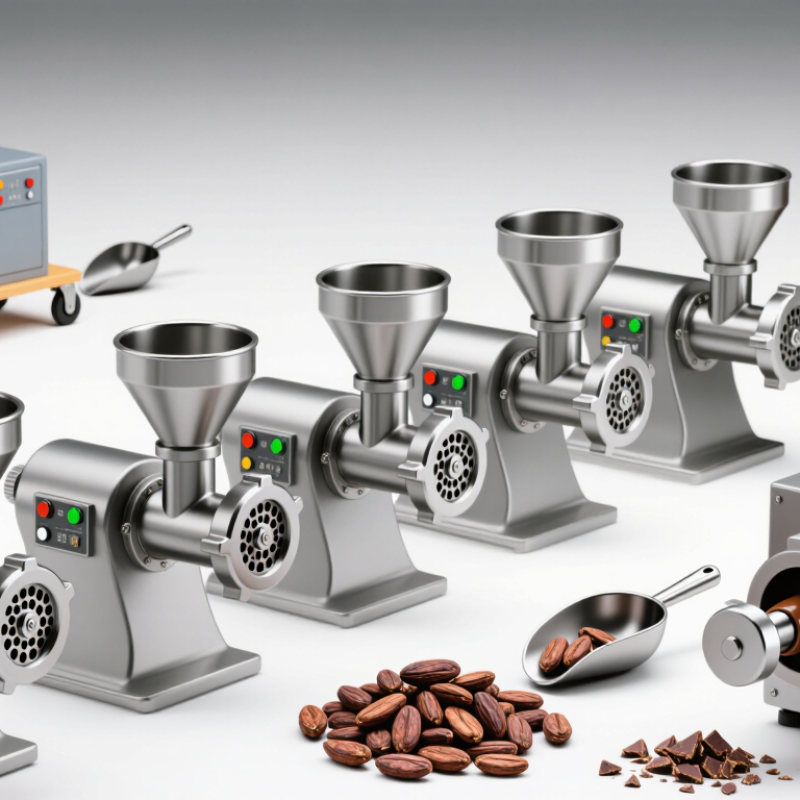
Pin mills and impact mills are common for grinding roasted cocoa nibs into cocoa liquor. They work quickly and suit medium or large processing lines. Disc mills provide adjustable grinding and can handle continuous production. Ball mills are useful for fine refining, especially when smooth chocolate liquor or cocoa-based fillings are required. Their slower action may improve texture, but temperature control remains critical.

Stone grinders and melangers suit small batches, craft production, and recipe development. Their gentle movement supports gradual flavor development in chocolate paste, nut-cocoa spreads, and specialty fillings. Colloid mills can process liquid cocoa mixtures into more uniform dispersions. They are often selected for sauces, beverages, and compound products.

The texture changes.

In practical plant trials, cooling systems often matter as much as grinding speed. Excess heat can darken the liquor and weaken flavor notes. Small batches matter. A machine that performs well in testing may struggle with sticky cocoa, uneven feeding, or cleaning delays. Suppliers should provide realistic capacity figures, food-contact material details, maintenance guidance, and trial samples before purchase. Operators may still need to adjust gap settings, feed rate, and cooling time. There is no perfect setting.

Key Features to Compare When Choosing a Cocoa Grinding Machine

Top Cocoa Grinding Machine Manufacturers and Suppliers

When comparing cocoa grinding machines, start with throughput, not brochure horsepower. The International Cocoa Organization’s 2023/24 report estimated global cocoa grindings at about 4.85 million tonnes. That pressure makes stable output important. Ask for measured capacity using your cocoa liquor, not a generic test powder. A machine rated for 1,000 kilograms per hour may produce less with high-fat beans or cooler feed material.

Particle size control deserves close attention. Check the target range, adjustment method, and test results from several production runs. A narrow particle distribution can improve mouthfeel and reduce rework. Temperature control also matters. Excess heat may darken liquor, change aroma, or increase maintenance needs. Look for jacketed cooling, temperature sensors, and an alarm history that operators can actually read. Simple controls often work better.

Hygienic design is practical, not decorative. Inspect seals, drain points, product-contact steel, and tool-free access around the grinding chamber. The U.S. Department of Agriculture’s Food Safety and Inspection Service repeatedly emphasizes sanitation and cleanable equipment in food processing environments. Energy use should be measured per tonne, including pumps and cooling systems. Noise, vibration, spare-part availability, and cleaning time belong in the quotation. I would not trust a supplier offering only a polished factory demonstration. Request a witnessed trial, maintenance records, and particle-size data from your own recipe. Small omissions become expensive.

Top Cocoa Grinding Machine Manufacturers and Suppliers: Throughput Ranges to Compare

Throughput is a practical starting point when comparing cocoa grinding machines. The ranges shown are representative operating levels commonly associated with different machine classes, not brand-specific performance claims. Final selection should also consider particle-size targets, motor power, cooling capacity, product temperature, sanitary design, and cleaning requirements.

Leading Cocoa Grinding Machine Manufacturers and Suppliers

Leading Cocoa Grinding Machine Manufacturers and Suppliers

Leading cocoa grinding machine manufacturers and suppliers support processors from bean preparation to final cocoa liquor production. The best partners understand heat control, particle size, cleaning, and continuous operation. According to the ICCO Annual Report 2023/24, global cocoa grindings were estimated at nearly 4.86 million tonnes. This volume shows why reliable grinding capacity matters.

Experienced manufacturers should provide test data using your cocoa variety, moisture level, and target fineness. A practical factory trial can reveal overheating, unstable viscosity, or difficult cleaning. Look for stainless-steel contact surfaces, adjustable rotor speed, temperature monitoring, and accessible wear parts. Suppliers should also explain installed power, throughput, noise levels, and maintenance intervals. These details often matter more than impressive brochures. A machine can look advanced and still fit poorly.

Tips: Request a sample trial, service response times, spare-part availability, and a clear warranty scope. Compare output at your real operating temperature. Ask how the supplier handles product changes. No machine suits every plant. That is easy to forget. I would also question unusually high capacity claims without independent test conditions. The International Cocoa Organization’s market data confirms a large, changing processing sector, but factory performance depends on feed quality and operator discipline. A reliable supplier should discuss those limitations openly, not hide them.

Manufacturing Standards, Quality Control, and Certification Requirements

Top Cocoa Grinding Machine Manufacturers and Suppliers

Manufacturing standards reveal how a cocoa grinding machine performs beyond its sales brochure. Reliable manufacturers use food-grade stainless steel in product-contact areas. They also document welding quality, surface finish, and hygienic design. Smooth internal corners reduce residue and simplify cleaning between batches. Machines should support stable particle size, controlled temperature, and consistent throughput during extended operation.

Quality control must continue from incoming materials to final factory testing. Technicians should verify motor performance, bearing alignment, sealing, vibration, and emergency-stop functions. Calibration records matter, especially for temperature sensors and pressure instruments. Traceability is equally important. Each critical component should have an inspection record and an identifiable batch reference. ISO 9001 supports controlled processes, while HACCP and GMP principles strengthen food-production hygiene. Depending on the market, electrical and safety certifications may also be required.

Tips: Ask for material certificates, inspection reports, and factory acceptance testing records. Request cleaning instructions with practical photographs. Check whether the supplier can provide installation training and spare-part support. A careful audit should include real production trials, not only polished sample videos. No factory is flawless. However, unclear answers about certificates, maintenance intervals, or test limits deserve attention. Certification alone does not guarantee excellent grinding results; documented performance and transparent corrective actions provide stronger evidence.

Top Cocoa Grinding Machine Manufacturers and Suppliers - Manufacturing Standards, Quality Control, and Certification Requirements

Category Manufacturing or Quality Requirement Typical Verification Evidence Relevant Standard or Certification Buyer Evaluation Point
Quality Management Documented procedures for design control, purchasing, production, inspection, nonconformity handling, and corrective action. Quality manual, process records, internal-audit reports, corrective-action records, and valid certificate scope. ISO 9001:2015 Confirm that the certificate covers the manufacture or supply of industrial food-processing machinery.
Food-Contact Materials Product-contact surfaces should be made from suitable corrosion-resistant materials, commonly stainless steel grades selected for food-processing service. Material certificates, surface-finish records, weld-inspection reports, and supplier declarations. Regulation (EC) No. 1935/2004; applicable national food-contact rules; FDA requirements where relevant. Check traceability for product-contact steel, elastomers, seals, lubricants, and coatings.
Hygienic Design Minimize dead zones, crevices, exposed threads, product retention areas, and difficult-to-clean internal surfaces. Hygienic-design drawings, cleanability assessment, drainage review, and cleaning instructions. EHEDG guidance or equivalent hygienic-design principles, where specified by the buyer. Verify that the grinding chamber can be opened, inspected, cleaned, and reassembled without contamination risks.
Mechanical Safety Guards, interlocks, emergency stops, safe access points, and protection from rotating shafts, belts, couplings, and grinding components. Risk assessment, safety-circuit test records, guarding inspection, and operating instructions. ISO 12100; applicable regional machinery-safety legislation. Require documented risk reduction measures and functional tests before shipment.
Electrical Safety Electrical panels, wiring, grounding, overload protection, control circuits, and emergency-stop functions must be correctly designed and labeled. Electrical schematics, insulation-resistance tests, protective-conductor checks, and panel inspection reports. IEC 60204-1; local electrical codes; UL or CSA requirements when contractually required. Confirm voltage, frequency, enclosure rating, control-panel language, and local approval requirements.
Dust and Explosion Risk Cocoa powder and other fine food particles may create combustible-dust hazards; dust collection, grounding, and ignition-source control may be required. Dust-hazard assessment, equipment classification, grounding-continuity tests, and dust-collector specifications. ATEX 2014/34/EU and 1999/92/EC where applicable; NFPA 61 and NFPA 652 where applicable. Do not assume certification is automatically required; determine the site classification and applicable jurisdiction first.
Grinding Performance The machine should achieve the agreed throughput, particle-size distribution, product temperature, and process stability for the specified cocoa mass or nib feed. Factory acceptance test, test sample report, particle-size analysis, throughput records, and temperature readings. Contract specifications and validated test methods; no single universal cocoa-grinding performance standard applies to all machines. Define feed material, moisture, fat content, inlet temperature, target fineness, capacity, and test duration in the purchase contract.
Temperature Control Cooling or temperature-monitoring systems should limit heat buildup that can affect cocoa flavor, viscosity, fat migration, and product quality. Calibrated sensor records, alarm tests, cooling-water or air-flow records, and batch temperature charts. Customer process specification and calibrated measurement procedures. Set alarm limits and acceptance criteria based on the recipe, equipment design, and validated process results.
Dimensional and Fabrication Control Critical dimensions, shaft alignment, rotor balance, weld quality, surface condition, and assembly tolerances should be controlled. Inspection plans, dimensional reports, balancing records, weld visual inspections, and non-destructive testing where specified. Approved engineering drawings, internal inspection procedures, and contractual quality plans. Request inspection records for critical rotating and product-contact components.
Calibration and Measurement Instruments used for temperature, pressure, speed, power, weighing, and particle-size verification should be identified and calibrated. Calibration certificates with equipment identification, measurement range, uncertainty, and due date. ISO 9001 measurement-control practices; ISO/IEC 17025 for competent calibration laboratories. Check calibration traceability and ensure instruments are suitable for the required measurement range.
Factory Acceptance Testing The completed machine should be tested under agreed operating conditions before dispatch. Signed FAT protocol covering no-load operation, loaded operation, capacity, product quality, safety devices, noise, vibration, and alarms. Project-specific inspection and test plan. Link payment milestones to objective test results and documented punch-list closure.
Installation and Commissioning Supplier documentation should define utilities, foundations, ventilation, dust extraction, piping, electrical connections, and commissioning procedures. General arrangement drawings, utility list, installation manual, commissioning checklist, and site-acceptance report. Applicable local building, electrical, pressure, and occupational-safety requirements. Confirm site conditions before order placement and define responsibility for utilities and integration.
Food Safety Management The supplier should support hygienic operation, contamination prevention, cleaning validation, allergen controls, and traceability within the user’s food-safety system. Hygiene procedures, cleaning instructions, material declarations, traceability records, and hazard-analysis documentation. HACCP principles; ISO 22000 where implemented by the food-processing organization. An ISO 22000 certificate belongs to the food-safety management system and does not by itself certify the machine.
Market Access Documentation The supplier should provide the conformity documentation required for the destination market. Declaration of Conformity, technical file or equivalent documentation, manuals, labels, and conformity assessment records. CE marking for applicable European requirements; UKCA or other national requirements where applicable. Certification and marking requirements depend on the destination country, machine configuration, and final installation.
After-Sales Support Availability of spare parts, preventive-maintenance schedules, troubleshooting procedures, training, and technical response support. Parts list, recommended spare-parts inventory, maintenance schedule, training records, and warranty terms. Contractual service-level requirements and applicable warranty obligations. Evaluate lifecycle cost, expected spare-parts lead time, remote-support capability, and technician availability.

Note: Certification requirements vary by destination market, machine configuration, installation environment, and contract scope. Product performance limits should be confirmed through a documented factory or site acceptance test using representative cocoa material.

How to Select, Purchase, and Maintain a Cocoa Grinding Machine

Selecting a cocoa grinding machine starts with your product, not the catalogue. Define daily output, target fineness, cocoa temperature, and available floor space. A machine for small batches may struggle during continuous production. Ask suppliers for material certificates, motor details, test results, and clear warranty terms. Request a sample trial using your cocoa beans, because published capacity can differ from real performance.

Inspect the grinding chamber, seals, bearings, and contact surfaces carefully. Food-grade stainless steel supports safer cleaning and longer service life. Check whether operators can remove residues without special tools. Fine cocoa dust can collect around vents and controls. Keep these areas clean and dry. Monitor motor noise, vibration, heat, and product texture during every shift. Record screen changes and maintenance dates. It sounds simple, but records are often incomplete.

Do not buy on price alone. Spare-part availability matters. So does technical training. A supplier should explain installation, lubrication points, safe shutdown, and troubleshooting steps. Leave space around the machine for inspection and airflow. Overloading the chamber may increase heat and produce uneven particles. That mistake is easy to make. Regular cleaning, belt inspection, and bearing checks help prevent expensive interruptions, although even a well-maintained grinder may need adjustment as cocoa characteristics change.